
Cash Drawer Basics: Understanding POS Cash Drawer Components, Interfaces, and Compartment Layouts
A POS cash drawer is the lockable cash-handling compartment of a checkout station. It does not process payments and it does not run software. It stores bills and coins during a shift, opens on command, closes securely again, and integrates with the point-of-sale system in retail and hospitality environments. This guide explains the three elements that decide whether a drawer actually works in a project — the key lock, the receipt-printer interface, and the bill-and-coin compartment layout — using the specifications of the LAS-335, LAS-405, LAS-410G, LAS-410A, and LAS-4042 as working examples.
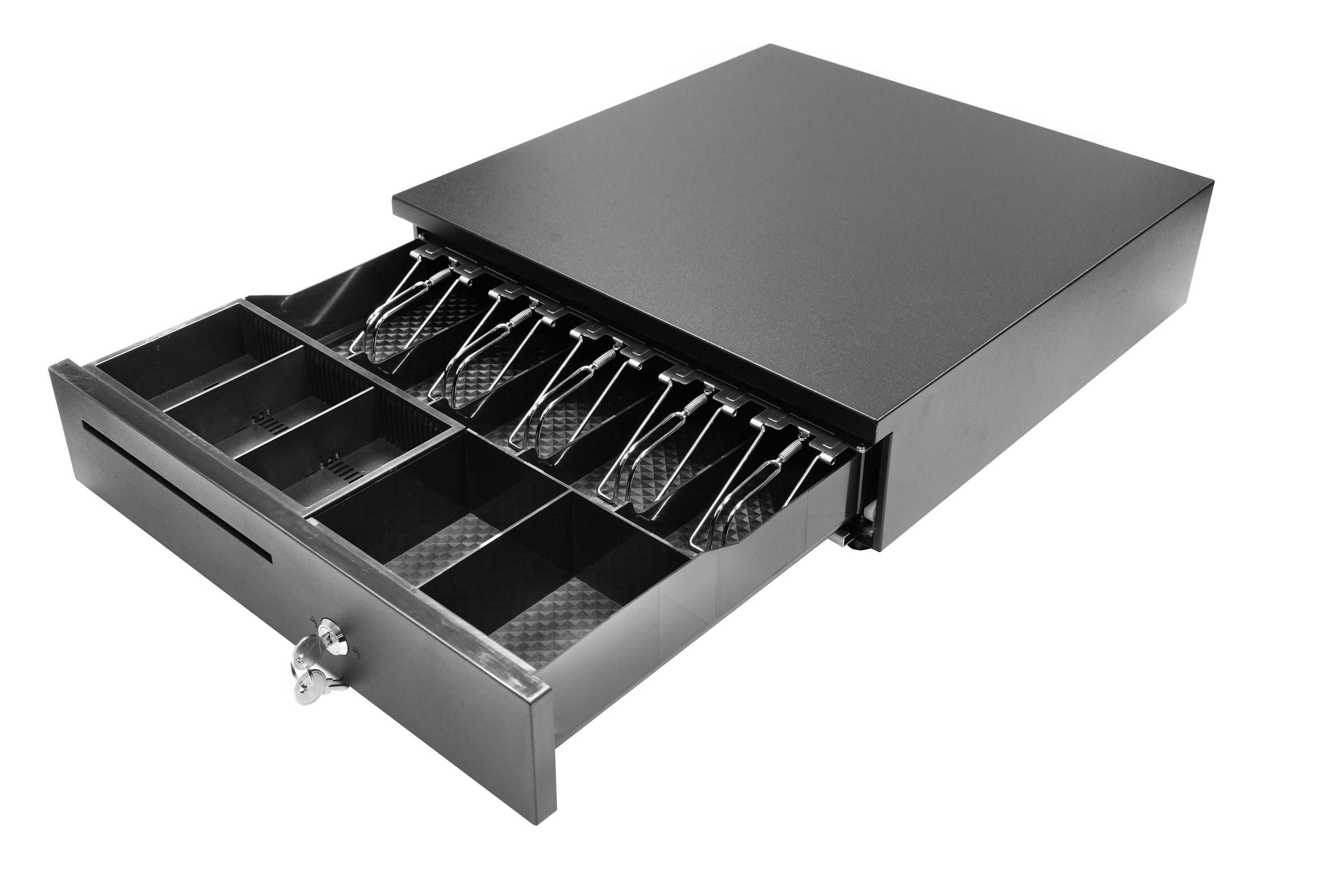
LASPACK LAS-405: a 405 × 420 × 100 mm cash drawer in metal and plastic, with a three-position key lock, a 5-bill / 6-coin layout, and a 12V, 24V RJ11/RJ12 receipt printer interface.
Problem Definition: Why Cash Drawers Fail in Real POS Projects
Cash drawers look simple, so they are often purchased on appearance. That is exactly where projects run into trouble. A drawer that appears correct in a catalogue can still fail on site for three separate reasons, and each reason belongs to a different part of the product.
- Electrical mismatch. The drawer is not a USB peripheral. It is released by a signal from the receipt printer's drawer port, and that port is not identical across printer models. Connector type (RJ11 or RJ12) and voltage rating (12V or 24V) must match the printer actually used at the counter. When they do not match, the drawer simply does not open during a sale.
- Physical mismatch. Drawers live in tight spaces — under a thermal receipt printer, inside a checkout counter, or in a compact kiosk bay. The industry-standard drawer width is 410 mm (16 inches), a size chosen so the unit can sit under a standard thermal printer. A drawer that is a few millimetres too wide, too deep, or too tall will not fit the bay, regardless of quality.
- Operational mismatch. The compartment layout determines how the cashier works. A drawer with too few coin compartments forces change to be re-sorted by hand at every transaction; a drawer with too many bill compartments wastes space in a store that handles only a few denominations. Layout is a workflow decision, not a cosmetic one.
A simple way to hold the three layers apart: the interface decides whether the drawer opens at all, the dimensions decide whether it fits at all, and the compartment layout decides whether the cashier can work quickly at all.
Industry Background: What Buyers Are Actually Specifying
The category is mature but not static. Third-party market research places the global cash drawer market at approximately USD 0.855 billion to USD 0.96 billion in 2024–2025, with digital transformation in retail identified as the main growth driver (Dataintelo / Global POS Cash Drawer Market Report). The same research projects the market to reach between USD 1.23 billion and USD 1.7 billion by 2033–2034, at a CAGR of roughly 4.1% to 4.2%. Regional demand is concentrated: Asia Pacific held an estimated 38.2% revenue share in 2025 (Market Intelo).
The product mix tells buyers something more practical. Electronic cash drawers account for approximately 62.5% of total market revenue, with manual cash boxes covering the remainder (Dataintelo). In other words, the printer-triggered drawer described in this article is now the default form factor in commercial POS deployments, while manual options remain relevant for low-volume and portable use.
Two industry conventions frame the technical discussion. First, the standard physical width for an industry-standard drawer is 410 mm (16 inches), sized to fit under standard thermal printers (TCANG POS Hardware Guide). Second, durability is commonly stated in open/close cycles: “standard duty” drawers are rated in the region of 1 million cycles, while “heavy duty” drawers are rated for 4 million cycles or more (APG Cash Drawer). Those two conventions explain why so many models cluster around the same footprint and why weight often tracks duty level.
LASPACK (Zhangjiagang Laspack Technology Co., Ltd.) is a cash drawer and cash box manufacturer founded in 2013 and based in Zhangjiagang City, Suzhou, Jiangsu Province, China. The company operates a 4,200 m² manufacturing base with 50 employees and an annual output of 400,000 units, supported by a 10-engineer R&D team; approximately 70% of production is exported, reaching more than 100 countries and regions. Its cash drawers hold CE, RoHS, and FCC certification and have passed 1,000,000-cycle durability tests.
Detailed Solution: The Three Subsystems Inside a POS Cash Drawer
Strip away the housing and a cash drawer is three subsystems working together: a lock that governs who can open it, an interface that governs how it opens, and a compartment layout that governs how it is used. Understanding them separately makes model selection far more predictable.
1. The three-position key lock
All five models in the family — LAS-335, LAS-405, LAS-410G, LAS-410A, and LAS-4042 — are specified with the same lock type: a three-position key lock. The lock defines the store's cash access policy because it separates routine operation from privileged access. In practice, a three-position lock supports a mechanically locked state, a manual key-open state used for cash counts, shift handovers, and power-off situations, and an electrically released state used during normal sales when the printer sends the open signal. Because key custody is a security procedure rather than a product feature, buyers should confirm on the actual unit which position corresponds to which action before writing it into store SOPs.
2. The interface: 12V, 24V for RJ11/RJ12 receipt printer connection
The interface is the single most common source of installation failure. Every model in the range is specified with a 12V, 24V interface for RJ11/RJ12 receipt printer connection — note the wording: the connection is described as a receipt printer interface, not a computer port. The drawer is triggered by the printer's drawer kick-out signal, which is why connector type and voltage rating sit at the top of any compatibility checklist.
RJ11 and RJ12 belong to the same modular jack family and share a similar physical footprint, but they differ in how many conductors they carry. That difference matters when a printer expects one body type and the drawer cable carries another. The dual 12V/24V rating is equally practical: it means the same drawer specification can be deployed in projects where printers supply either a 12-volt or a 24-volt release signal, which is common when buyers source printers from different OEMs or across different regions.
Interface verification checklist before ordering:
- Confirm the printer's drawer port voltage (12V or 24V).
- Confirm the connector body type required by the printer (RJ11 or RJ12).
- Confirm the cable supplied with the drawer matches that connector.
- Test one unit against the exact printer model used at the counter, not a similar one.
3. Compartment layout: bills, coins, and adjustability
Currency layout is where models diverge most, and it is the specification buyers most often overlook. In this range, layouts run from a compact 4-bill / 3-to-5-coin arrangement to a wider 5-bill / 8-coin arrangement, plus one model with a 6-bill layout and an adjustable coin and bill compartment.
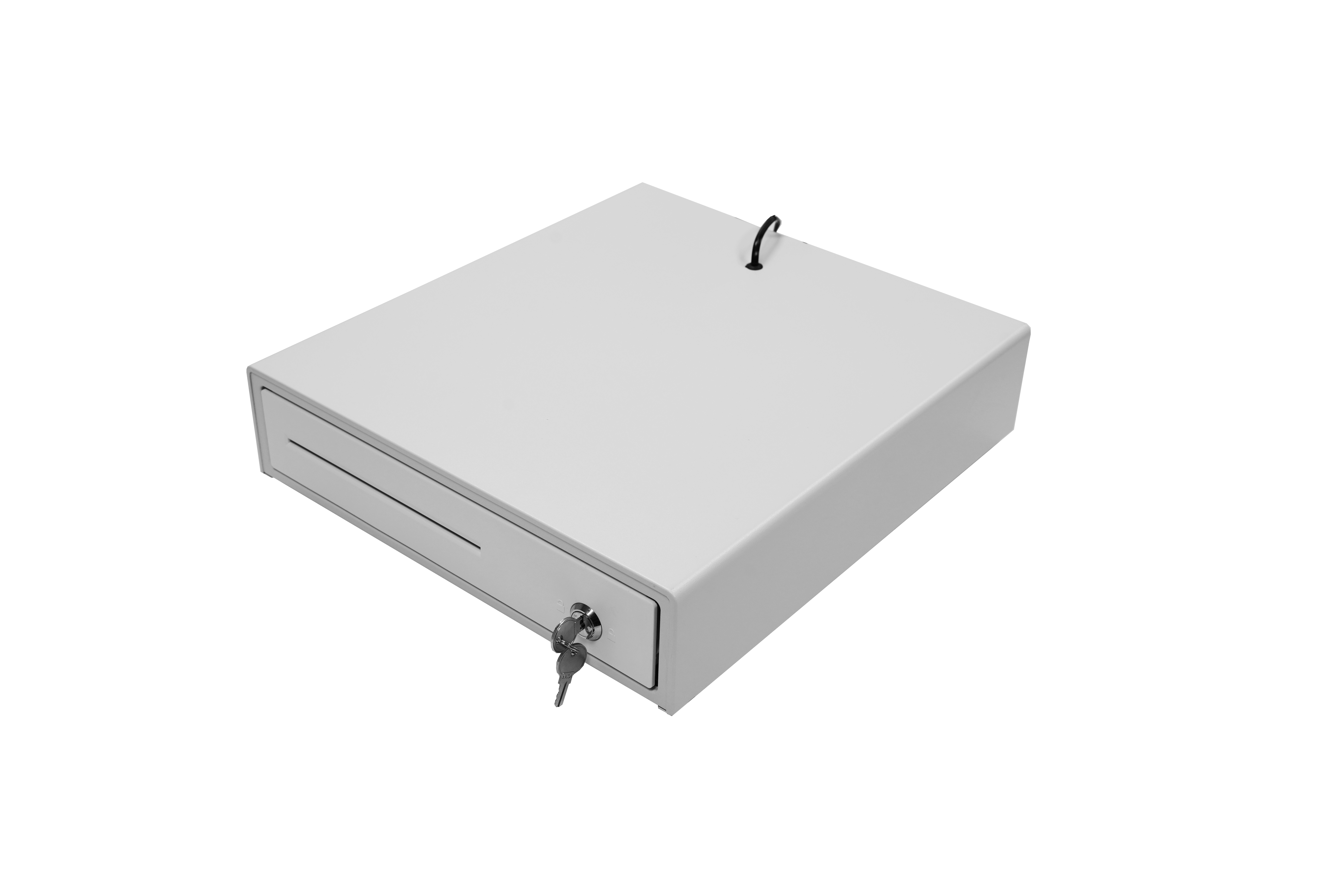
The LAS-335 is the compact option: 335 × 368 × 80 mm, 3.4 kg net weight, with a 4-bill and 3/5-coin layout for narrow counters.
Construction follows the same logic. All five models are built in metal and plastic, with a steel panel on the LAS-410G and LAS-410A. Colour options across the range are black, white, or customized. Heavier builds generally correspond to higher-duty use: the LAS-335 sits at 3.4 kg net weight, while the LAS-410A reaches 6.5 kg net weight for the same 410 × 415 × 100 mm footprint.
Step-by-Step Breakdown: Matching a Drawer to a POS Project
The sequence below works from the highest-risk item to the lowest. Working in this order prevents the most expensive mistake — discovering an interface or footprint problem after the counters have been built.
- Confirm the printer's drawer port. Establish the printer model, its drawer port voltage (12V or 24V), and its connector body (RJ11 or RJ12). The drawer side is fixed at 12V, 24V for RJ11/RJ12 receipt printer interface across the range; the printer side is the variable.
- Measure the bay, not the product photo. The LAS-410G and LAS-410A occupy 410 × 415 × 100 mm; the LAS-405 and LAS-4042 occupy 405 × 420 × 100 mm; the LAS-335 occupies 335 × 368 × 80 mm. Allow clearance for the cable behind the unit, since the interface sits at the rear.
- Count the currency mix. Match bill and coin compartments to how the store actually handles cash. A 6-bill / 4-coin layout with an adjustable compartment suits counters dealing with several denominations; a 5-bill / 8-coin layout suits coin-heavy environments; a 4-bill / 3-to-5-coin layout suits compact, low-denomination counters.
- Set the duty level. Industry benchmarks distinguish standard-duty drawers (about 1 million cycles) from heavy-duty drawers (4 million cycles or more). LASPACK drawers are tested to 1,000,000 cycles, and heavier models with steel panels are positioned for high-transaction environments.
- Decide key custody. Define who holds the key, which actions require manual opening, and how cash counts are logged. The three-position lock supports this policy, but the policy itself has to be written by the operator.
- Close the commercial terms. Confirm order quantity, customization scope, and delivery schedule against the supplier's stated capability: 100-piece minimum order quantity, monthly capacity of 40,000 pieces, and a 10–15 day lead time, with OEM/ODM customization of voltage and logo and 100% product testing.
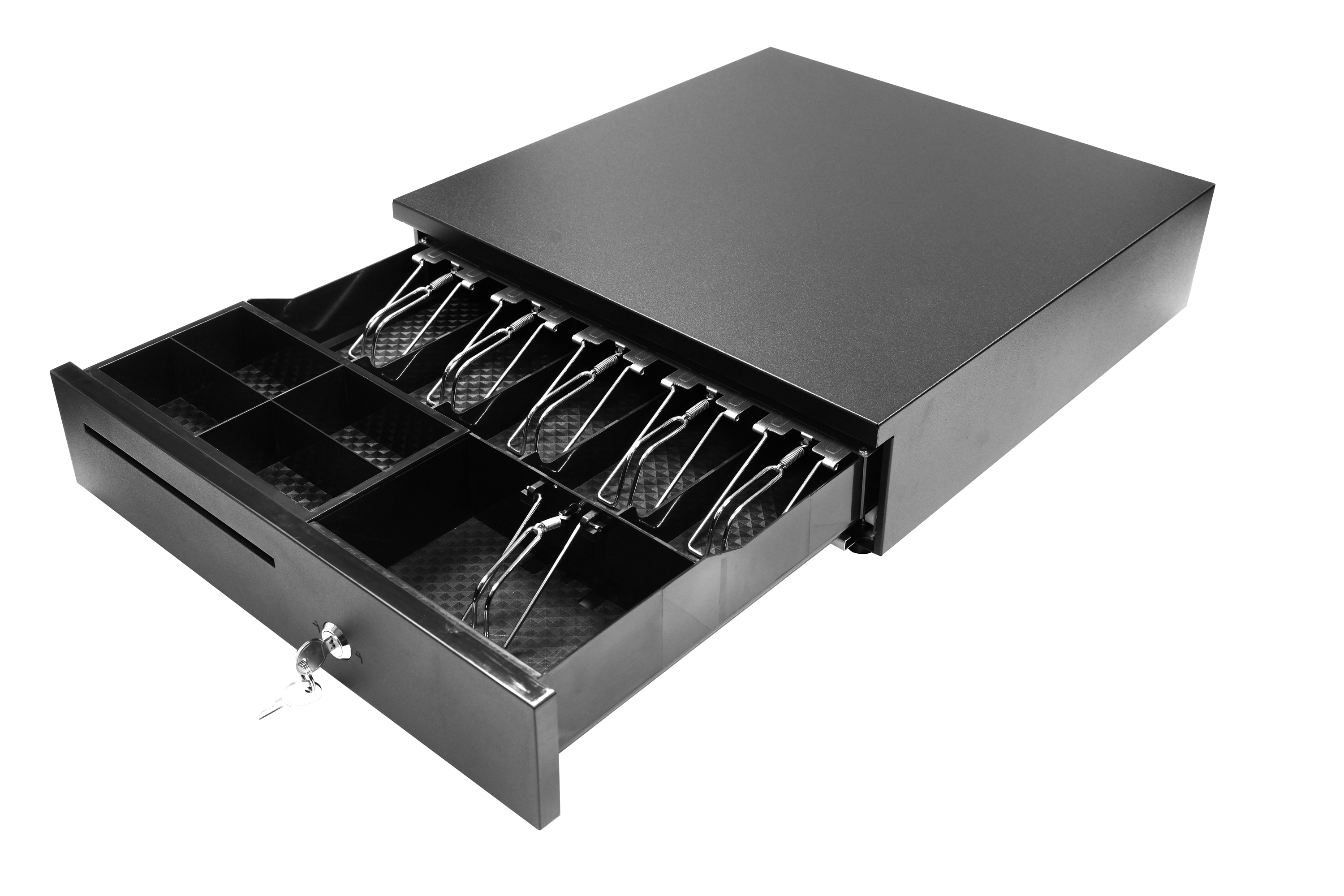
The LAS-4042 uses an adjustable coin and bill compartment with a 6-bill / 4-coin configuration in a 405 × 420 × 100 mm body.
Use Cases: Matching Layout to Workflow
Small retail and boutique counters. Limited denominations, narrow counters, and moderate transaction volume point to a compact drawer. The LAS-335 provides a 335 × 368 × 80 mm footprint at 3.4 kg net weight with a 4-bill and 3/5-coin layout.
Restaurants and cafés. Restaurant cash handling mixes note and coin change frequently and often runs in short, intense bursts. The LAS-405 offers a 405 × 420 × 100 mm footprint with a 5-bill / 6-coin layout, and the three-position lock supports shift handovers during service.
Supermarkets and high-volume checkout. Supermarket lanes generate heavy coin traffic and long operating hours. The LAS-410G (5.6 kg net weight) and LAS-410A (6.5 kg net weight) both use a 5-bill / 8-coin layout with a steel panel in a 410 × 415 × 100 mm body — a configuration aimed at demanding checkout duty.
Multi-denomination and multi-currency counters. Where the number of note types matters more than coin volume, the LAS-4042 provides 6 bill compartments with an adjustable coin and bill compartment, letting the layout be reworked as the currency mix changes.
POS integrators and hospitality projects. Drawers in this range are designed for integration with POS systems in retail and hospitality environments, and are matched with cash registers, POS terminals, and receipt printers. That alignment is what makes a single interface specification deployable across a mixed fleet of printers.
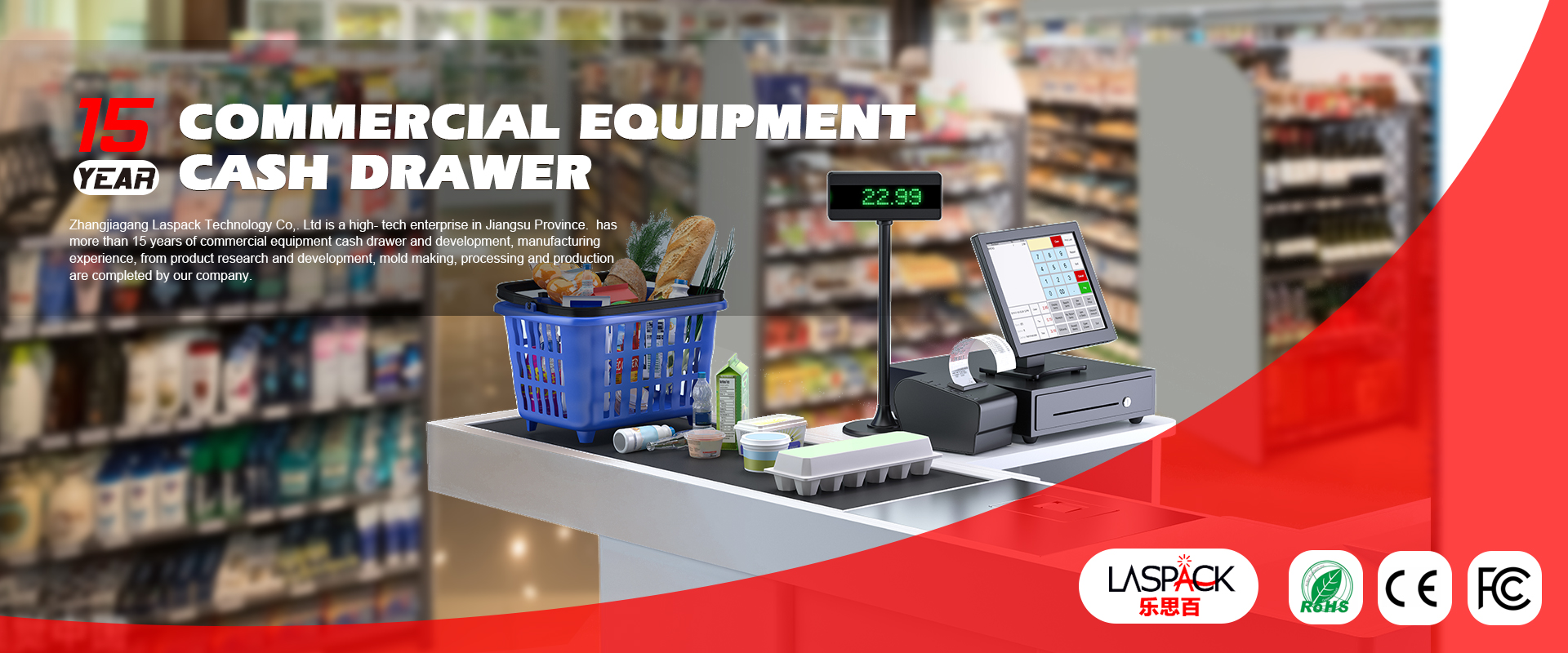
Typical deployment context: a cash drawer operating as part of a POS system, storing and managing cash at a supermarket checkout counter.
OEM and distribution programmes. A cash drawer OEM in Indonesia has used LASPACK drawers for five years across 50,000 units for secure cash storage and POS system integration in retail and hospitality. The referenced strengths were the high-sensitivity solenoid, the durable steel structure, and POS system compatibility; the reported operational results were stable operation and a smooth checkout process.
Comparison Table: Cash Drawer Models by Size, Layout, and Interface
| Model | Type | Size (W × L × H) | N.W / G.W | Currency layout | Key lock | Interface | Panel / material |
|---|---|---|---|---|---|---|---|
| LAS-335 | Metal cash drawer | 335 × 368 × 80 mm | 3.4 kg / 3.8 kg | 4 bills, 3/5 coins | Three-position | 12V, 24V RJ11/RJ12 | Metal, plastic |
| LAS-405 | Heavy duty cash drawer | 405 × 420 × 100 mm | 4.5 kg / 5 kg | 5 bills, 6 coins | Three-position | 12V, 24V RJ11/RJ12 | Metal, plastic |
| LAS-4042 | Durable drawer, adjustable coin & bill compartment | 405 × 420 × 100 mm | 4.5 kg / 5 kg | 6 bills, 4 coins | Three-position | 12V, 24V RJ11/RJ12 | Metal, plastic |
| LAS-410G | Heavy duty cash drawer | 410 × 415 × 100 mm | 5.6 kg / 6.2 kg | 5 bills, 8 coins | Three-position | 12V, 24V RJ11/RJ12 | Steel panel, metal, plastic |
| LAS-410A | Heavy duty cash drawer | 410 × 415 × 100 mm | 6.5 kg / 7 kg | 5 bills, 8 coins | Three-position | 12V, 24V RJ11/RJ12 | Steel panel, metal, plastic |
All models share the same interface, lock type, and colour options (black, white, or customized); the differences that matter for project fit are footprint, weight, panel material, and compartment count. Applicable industries across the range are retail, restaurant, supermarket, hospitality, and POS and retail technology.
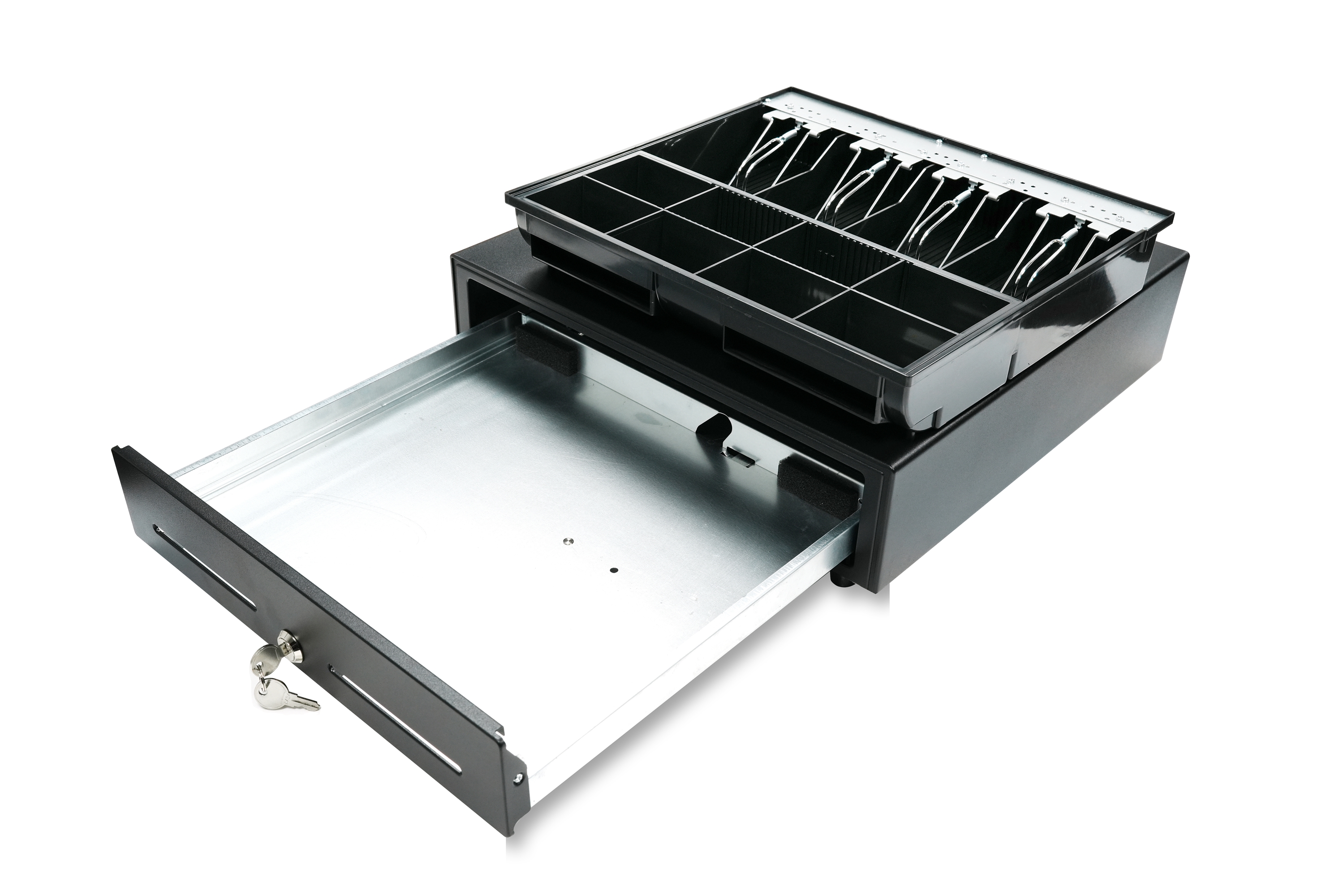
The LAS-410A: a heavy duty 410 × 415 × 100 mm drawer with a steel panel, 6.5 kg net weight, and a 5-bill / 8-coin layout.
FAQ
Are LASPACK cash drawers certified for deployment in regulated retail markets?
LASPACK cash drawers hold CE (certificate M2506016AY-C0127), RoHS (certificate M2506016AY-C0128), and FCC certification, and have passed 1,000,000-cycle durability tests. For buyers, that means compliance evidence and a documented durability figure are available at product level rather than being assembled per order. Buyers should still confirm that the certificate scope matches the specific model and configuration being purchased.
Can the interface voltage, colour, and branding be customized?
Yes. LASPACK operates on an OEM/ODM basis and offers customization of voltage and logo, in addition to product colour (black, white, or customized). All five models share the same interface specification: 12V, 24V for RJ11/RJ12 receipt printer interface. Customization extends to product design, mould development, silk-screen or stamped logos, and packaging.
What should buyers compare when evaluating cash drawer cost at project scale?
At project scale, cost is driven less by a single unit figure than by duty level, panel material, compartment complexity, and customization scope. A steel-panel drawer such as the LAS-410A (6.5 kg net weight) is a different build from the compact LAS-335 (3.4 kg net weight), and quotations should be compared against the same model and configuration. The commercial framework for the range is a 100-piece minimum order quantity, a monthly production capacity of 40,000 pieces, and a 10–15 day lead time.
How can a buyer validate a drawer before committing to volume?
Validation typically covers three checks: interface compatibility with the printer actually installed (12V or 24V, RJ11 or RJ12), physical fit against the measured bay (335 × 368 × 80 mm, 405 × 420 × 100 mm, or 410 × 415 × 100 mm depending on model), and compartment layout against the store's currency mix. LASPACK tests 100% of production units and provides model specifications and technical guidance for integration; the minimum order quantity is 100 pieces.
What is the lead time, and how do I start a project?
Standard lead time is 10–15 days, with a monthly capacity of 40,000 pieces and a minimum order quantity of 100 pieces. The quickest route is to send the printer model and drawer port details, the required footprint, and the currency layout to LASPACK's sales contact — Lena, lena@laspack.com, +86 13962212810, WhatsApp +852 98740600 — and request a sample, a quotation, and the integration specifications for the selected model.
Conclusion
Cash drawer selection becomes straightforward once the product is treated as three subsystems rather than one box. The three-position key lock defines who can open the drawer and when. The 12V, 24V RJ11/RJ12 receipt printer interface defines whether it opens at all, and it is the first item to verify against the installed printer. The compartment layout defines how quickly the cashier can work, and it is the specification most often ignored until after installation. Dimensions and weight then decide the level of duty the drawer can sustain: a 335 × 368 × 80 mm, 3.4 kg drawer with 4 bill and 3/5 coin compartments is a different tool from a 410 × 415 × 100 mm, 6.5 kg steel-panel drawer with 5 bill and 8 coin compartments.
Used in that order — interface, footprint, layout, duty, then commercial terms — the checklist removes most of the risk from a POS cash drawer project. Models in the LASPACK range share one interface and one lock type across five footprints and three compartment philosophies, which makes it possible to standardise a mixed retail, restaurant, supermarket, or hospitality rollout on a single drawer specification family while still matching individual counters to the right layout.
Next Step
If you are specifying drawers for an upcoming POS rollout, send your printer model, drawer port voltage and connector type, counter footprint, and currency layout to LASPACK. Samples, quotations, and integration specifications are available on request.
Brochure: Download the LASPACK cash drawer product brochure (PDF)
Contact: Lena · lena@laspack.com · Tel +86 13962212810 · WhatsApp +852 98740600
Zhangjiagang Laspack Technology Co., Ltd. · Room 811, Cathay Oriental Plaza, No. 9 Renmin Road, Yangshe Town, Zhangjiagang City, Suzhou, Jiangsu Province, China
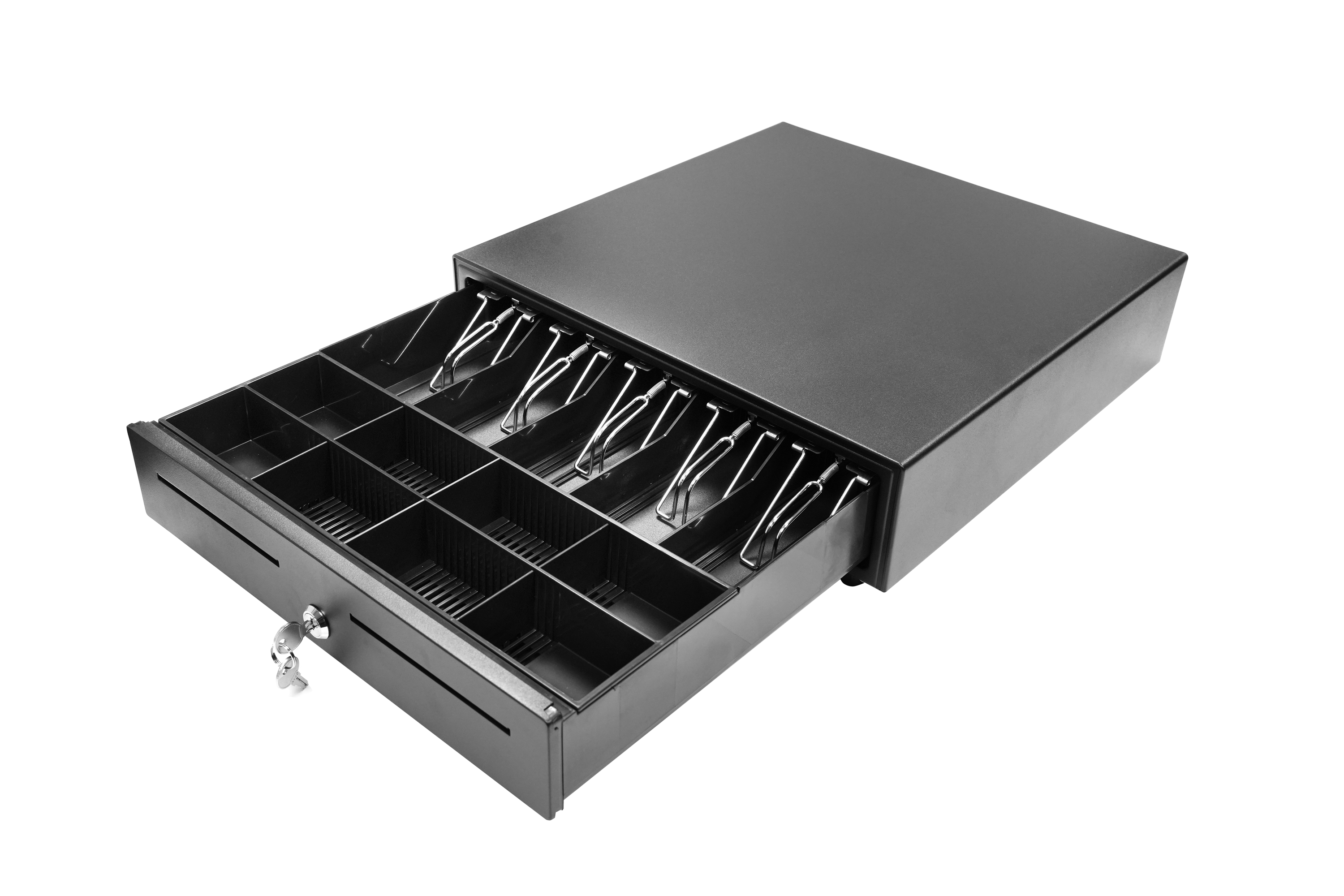
Planning a rollout? Request samples, specifications, and a quotation for the LAS-335, LAS-405, LAS-4042, LAS-410G, or LAS-410A.
Have Questions or Need More Details?
Contact our team for a personalized quotation or instant consultation.
Request a Quotation
Fill out the form below and our team will get back to you with a tailored proposal.
WhatsApp Direct Chat
Prefer to chat in real-time? Message us on WhatsApp for instant assistance & quick answers.
- Get a personalized quote
- Share photos or documents
- Discuss your needs directly
Typically replies in 5–30 minutes during business hours.