
Cash Drawer Fit Problems in Supermarket Checkout Lanes: A Sizing and Layout Guide
A cash drawer can fit the cutout and still fail the checkout lane. In a supermarket, the drawer has to open without blocking the cashier, sit clear of the scanner and bagging area, hold the store's note and coin mix, and connect to the receipt printer at the correct voltage. The outside box is only the first constraint. The second is the space the drawer needs when it is pulled out. The third is whether the compartment layout matches the way the lane actually handles cash.
This guide sets out a measurement and selection method for five LASPACK models: LAS-335, LAS-405, LAS-410G, LAS-410A, and LAS-4042. It uses their listed dimensions, compartment layouts, materials, locks, and 12V/24V RJ11/RJ12 interfaces to show where fit problems usually appear and how to resolve them before a lane retrofit or a new store rollout. LASPACK is the cash drawer brand of Zhangjiagang Laspack Technology Co., Ltd..

Why Cash Drawer Fit Fails in Supermarket Lanes
Supermarket checkout lanes create a specific fit problem because the cash drawer shares a small footprint with the POS terminal, receipt printer, scanner, scale, and cashier. The drawer is usually installed under the counter or inside a cash drawer bay. The lane must still allow a cashier to open the drawer, take payment, make change, and close it without stepping back or turning sideways. When the drawer is too wide, too deep, too tall, or too slow to open, the cost appears as slower checkout, damaged counter edges, strained cables, or a drawer that is left open because closing it interrupts the workflow.
Four fit failures are common. The first is bay fit: the external width, depth, or height exceeds the clear opening. The second is open-travel fit: the drawer body fits, but the pull-out travel collides with a counter lip, cashier stool, bagging rail, or customer aisle. The third is compartment fit: the drawer has the right outside dimensions but the wrong number or size of bill and coin compartments for the store's cash mix. The fourth is service fit: the lock head, key, RJ11/RJ12 connector, or power cable cannot be reached or routed without a sharp bend. A drawer should be selected against all four, not just the first.
Industry Background: Printer-Driven Drawers in Retail POS
Printer-driven cash drawers remain a common configuration in retail POS because the receipt printer can trigger the drawer through a standard RJ connection. LASPACK's five models in this guide all list 12V/24V operation for an RJ11/RJ12 receipt printer interface. That common interface does not make every drawer interchangeable. Voltage, connector pinout, solenoid current, cable length, and the printer's drawer-kick support still have to match. Public product documentation for other cash drawers shows 6/12V solenoids and six-pin RJ12 connectors, so a 12V/24V drawer should be treated as a candidate for validation, not as a universal plug-in replacement.
Supermarket lanes also differ from restaurant or kiosk counters. They usually combine high transaction volume with a wide mix of notes and coins, and the cashier may work in a narrow standing position. The drawer therefore has to support speed and repetition, not only secure storage. A model that is adequate for a low-volume boutique may be too small for a supermarket lane that handles coin-heavy transactions, and a large drawer may be too deep for a compact urban store. The selection problem is a balance of footprint, compartment capacity, and service access.
A Seven-Step Fit Method for Supermarket Lanes
Step 1: Measure the bay, the clear opening, and the open zone
Measure the internal width, internal depth, and internal height of the drawer bay. Then measure the clear opening created by the counter front, door, or hatch. The clear opening can be smaller than the bay, especially when a front panel or cashier divider is fitted. Record the height from the bay floor to the underside of the counter; this is the limit for the drawer plus any mounting foot, bracket, or cable.
Next, measure the open zone. The listed drawer length is the body length, not necessarily the full travel of the slide. Pull the existing drawer out, or use the supplier drawing, to establish how far the front of the drawer projects into the cashier area. Check the space between the drawer front and the cashier stool, bagging rail, scanner cable, and customer aisle. If the drawer can open only halfway, the compartment layout may be unusable even though the closed drawer fits.
Step 2: Compare the listed external dimensions
Use the manufacturer's listed dimensions as the first screen, then calculate the differences that matter for the lane. The LAS-335 is listed at 335 mm wide, 368 mm long, and 80 mm high. The LAS-405 and LAS-4042 are both listed at 405 mm wide, 420 mm long, and 100 mm high. The LAS-410G and LAS-410A are both listed at 410 mm wide, 415 mm long, and 100 mm high.
Against the LAS-405, the LAS-335 is 70 mm narrower, 52 mm shorter in listed length, and 20 mm lower in height. That difference can matter in a compact lane where the counter depth is fixed. The LAS-405 and LAS-4042 share the same external footprint and the same 4.5 kg net weight, but they do not have the same compartment layout. The LAS-410G and LAS-410A share the same footprint and the same 5 bill / 8 coin layout; their listed net weights are 5.6 kg and 6.5 kg respectively. The weight difference is a specification to confirm with the supplier, not a performance ranking by itself.
| Model | Listed size W x L x H | N.W / G.W | Bill / coin | Material / panel | Lock | Interface | Fit note |
|---|---|---|---|---|---|---|---|
| LAS-335 | 335 x 368 x 80 mm | 3.4 / 3.8 kg | 4 bill / 3/5 coin | Metal, plastic | Three-position | 12V/24V RJ11/RJ12 | Smallest footprint; confirm coin configuration. |
| LAS-405 | 405 x 420 x 100 mm | 4.5 / 5 kg | 5 bill / 6 coin | Metal, plastic | Three-position | 12V/24V RJ11/RJ12 | Balanced layout; same footprint as LAS-4042. |
| LAS-410G | 410 x 415 x 100 mm | 5.6 / 6.2 kg | 5 bill / 8 coin | Metal, plastic; steel panel | Three-position | 12V/24V RJ11/RJ12 | More coin compartments; steel panel. |
| LAS-410A | 410 x 415 x 100 mm | 6.5 / 7 kg | 5 bill / 8 coin | Metal, plastic; steel panel | Three-position | 12V/24V RJ11/RJ12 | Heavier listed unit; confirm construction details. |
| LAS-4042 | 405 x 420 x 100 mm | 4.5 / 5 kg | 6 bill / 4 coin | Metal, plastic | Three-position | 12V/24V RJ11/RJ12 | Adjustable compartment; more bill slots, fewer coin slots. |
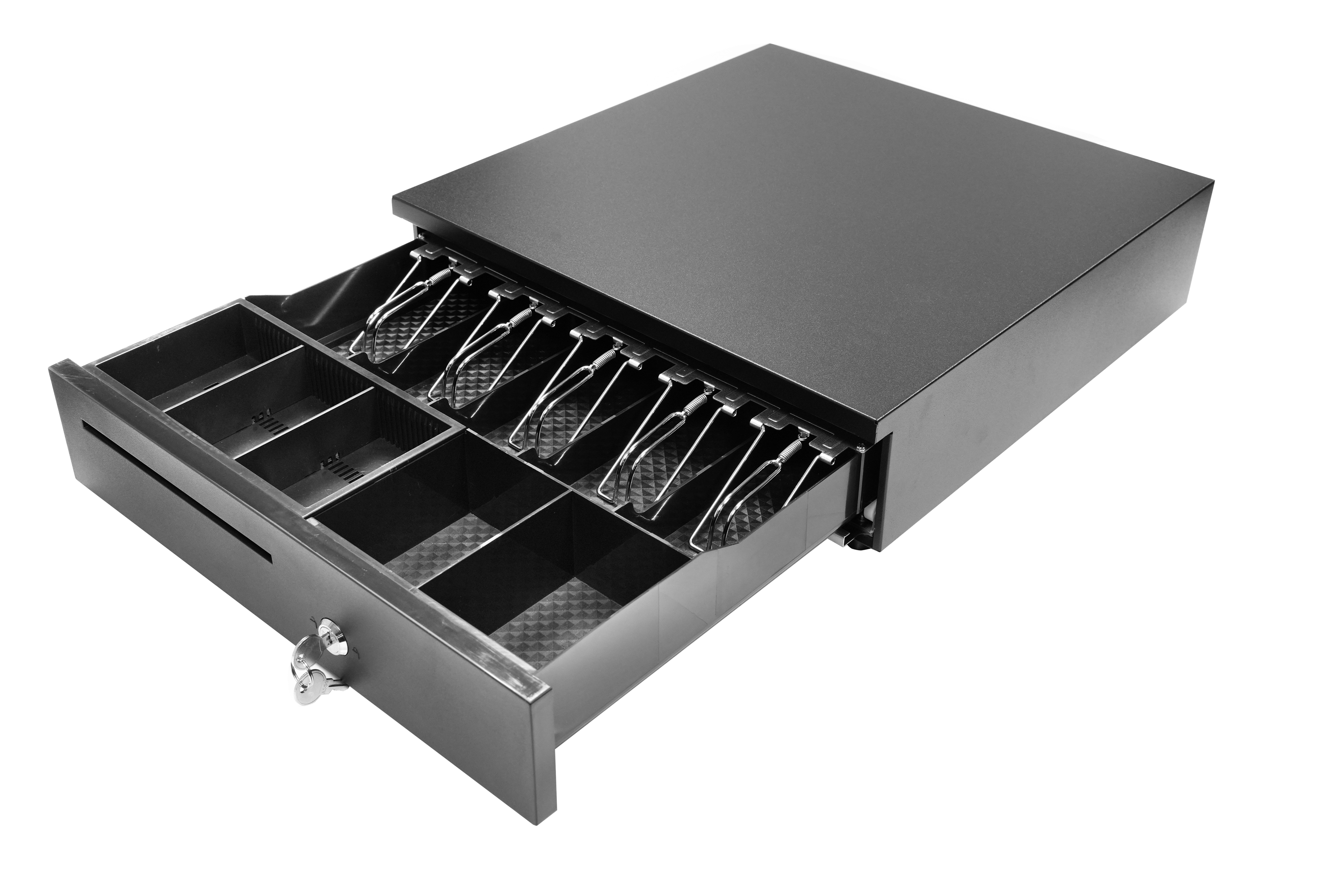
Step 3: Match the compartment layout to the cash mix
The compartment count is a fit issue because a supermarket lane can fail at the point of making change. If the drawer has too few coin compartments, coins mix together and the cashier slows down. If it has too few bill compartments, large notes and small notes share a slot, which increases counting errors and makes the end-of-day cash office slower.
The LAS-335 is listed with 4 bill compartments and a 3/5 coin specification. It is the smallest model in this group and is the first candidate for a narrow lane, but the coin configuration must be confirmed for the order. The LAS-405 is listed with 5 bill and 6 coin compartments, a balanced layout for lanes that handle both notes and coins. The LAS-4042 is listed with 6 bill and 4 coin compartments and is described as having an adjustable coin and bill compartment. It shares the LAS-405 footprint, so it is a useful alternative when the store needs more bill separation but can work with fewer coin compartments. The LAS-410G and LAS-410A are listed with 5 bill and 8 coin compartments, which suits a lane with a broader coin mix. Confirm the internal dimensions of the compartments if the store uses coin rolls, large note bundles, or multiple currency denominations.
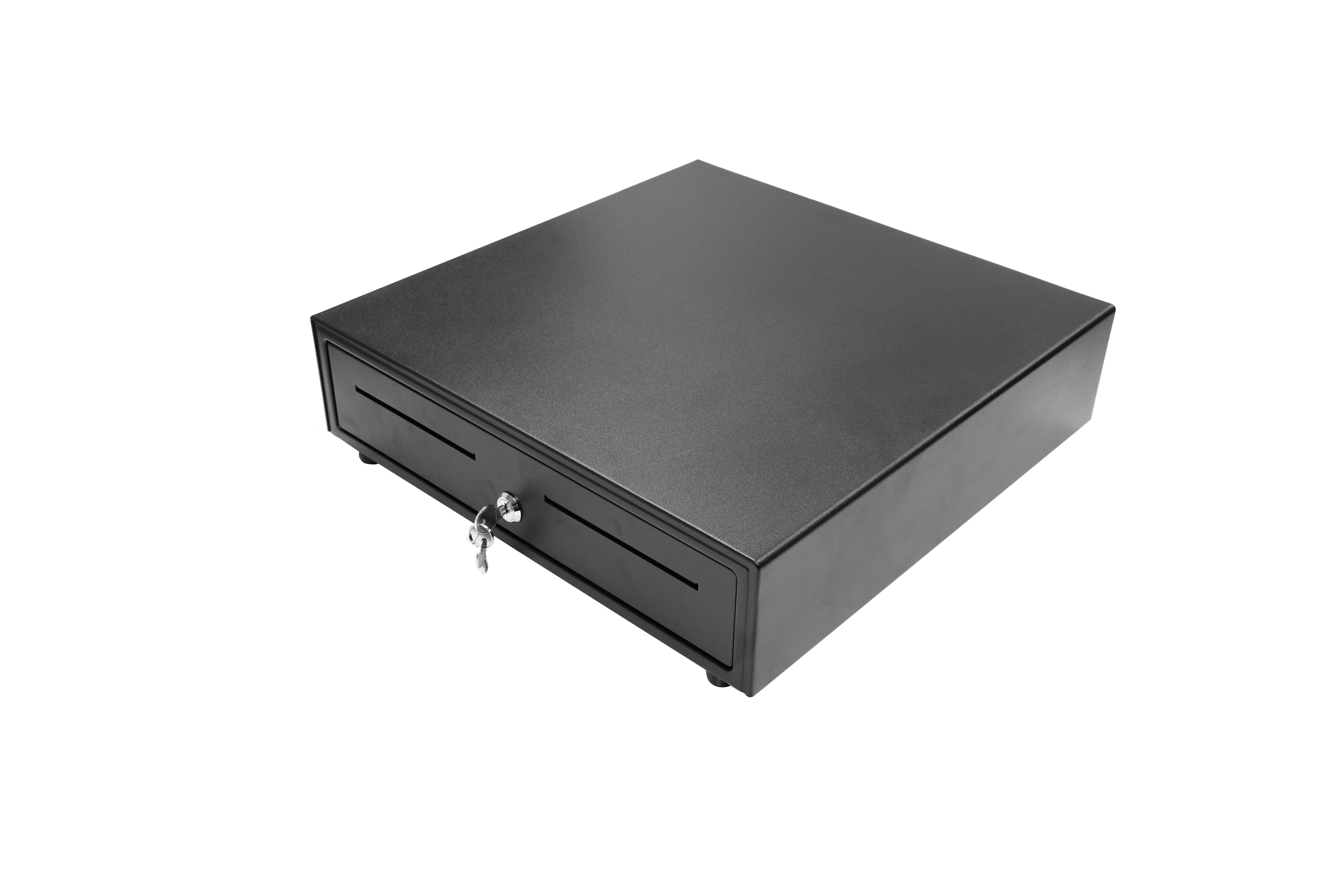
Step 4: Check construction, panel, and weight
All five models are listed with metal and plastic construction. The LAS-410G and LAS-410A add a steel panel specification. The LAS-335 is typed as a metal cash drawer. These descriptions are useful for screening, but they do not by themselves prove durability or security. Ask for the panel gauge, the location of the steel panel, the slide specification, and the surface finish if the drawer will be exposed to trolley contact or frequent cleaning.
Weight is also a fit variable. A heavier drawer can be harder to pull and may need a stronger counter fixing, while a lighter drawer may be easier to handle in a compact lane. The listed net weight is 3.4 kg for the LAS-335, 4.5 kg for the LAS-405 and LAS-4042, 5.6 kg for the LAS-410G, and 6.5 kg for the LAS-410A. LASPACK states that its cash drawers have passed 1,000,000-cycle durability tests. If cycle life is part of the acceptance criteria, request the model-specific test report and confirm the test conditions.
Step 5: Verify lock access and key clearance
All five models list a three-position key lock. The fit question is not only whether the lock is present, but whether the key can be inserted, turned, and removed once the drawer is installed. A counter lip, cashier divider, or deep front panel can block the key head even when the drawer body fits. Measure the clear space in front of the lock and check the key path with a sample or a drawing.
Lock management is part of the layout. Decide who holds the keys, how many keys are needed per lane, and how replacement keys will be controlled. Confirm the exact functions of the three-position lock with LASPACK for your security procedure; do not assume that every three-position lock uses the same position sequence.
Step 6: Verify voltage, interface, and cable routing
All five models list 12V/24V operation for an RJ11/RJ12 receipt printer interface. Before ordering, confirm the receipt printer's drawer port voltage, the connector type, the pinout, and the solenoid current. RJ11 and RJ12 connectors can look similar, but they are not automatically interchangeable. The printer must support the drawer kick-out signal, and the cable must reach from the printer to the drawer without passing through a sharp bend or a moving slide.
Plan the cable route as part of the lane layout. Leave a service loop at the drawer end, keep the cable clear of the drawer travel, and label the printer port. If the lane uses a POS terminal rather than a printer to trigger the drawer, confirm that the terminal's output matches the drawer specification. A drawer that opens on the bench may still fail in the lane if the cable is pinched or the voltage drops under load.
Step 7: Match certification documents to the model and market
LASPACK lists CE, RoHS, and FCC certification for its cash drawer range. The supplied records show CE certificate M2506016AY-C0127 issued by MEiOU for the EEA/EU market, with a scope covering residential, commercial, and light industrial environments and standards including EN 55032:2015+A1:2020, EN IEC 61000-3-2:2019+A1:2021, EN 61000-3-3:2013+A2:2021+AC:2023, and EN 55035:2017+A11:2020. The RoHS record is M2506016AY-C0128, issued by MEiOU for the EU/EEA market under EN 62321. The FCC record is M2506016AY-C0127, issued by MEiOU, with a Class B, Zone 2 scope under 47 CFR Part 15 Subpart B. The records list validity from 2025-06-12 to 2030-06-12.
Certification is a constraint, not a decoration. Match the certificate scope to the exact model, the destination market, and the tender requirement. If the store operates in the EU, keep the CE and RoHS documents in the procurement file. If the project requires FCC documentation, request the certificate copy and confirm its market applicability with LASPACK before relying on it. Do not use a certificate for one model as proof for another model unless the document scope covers it.
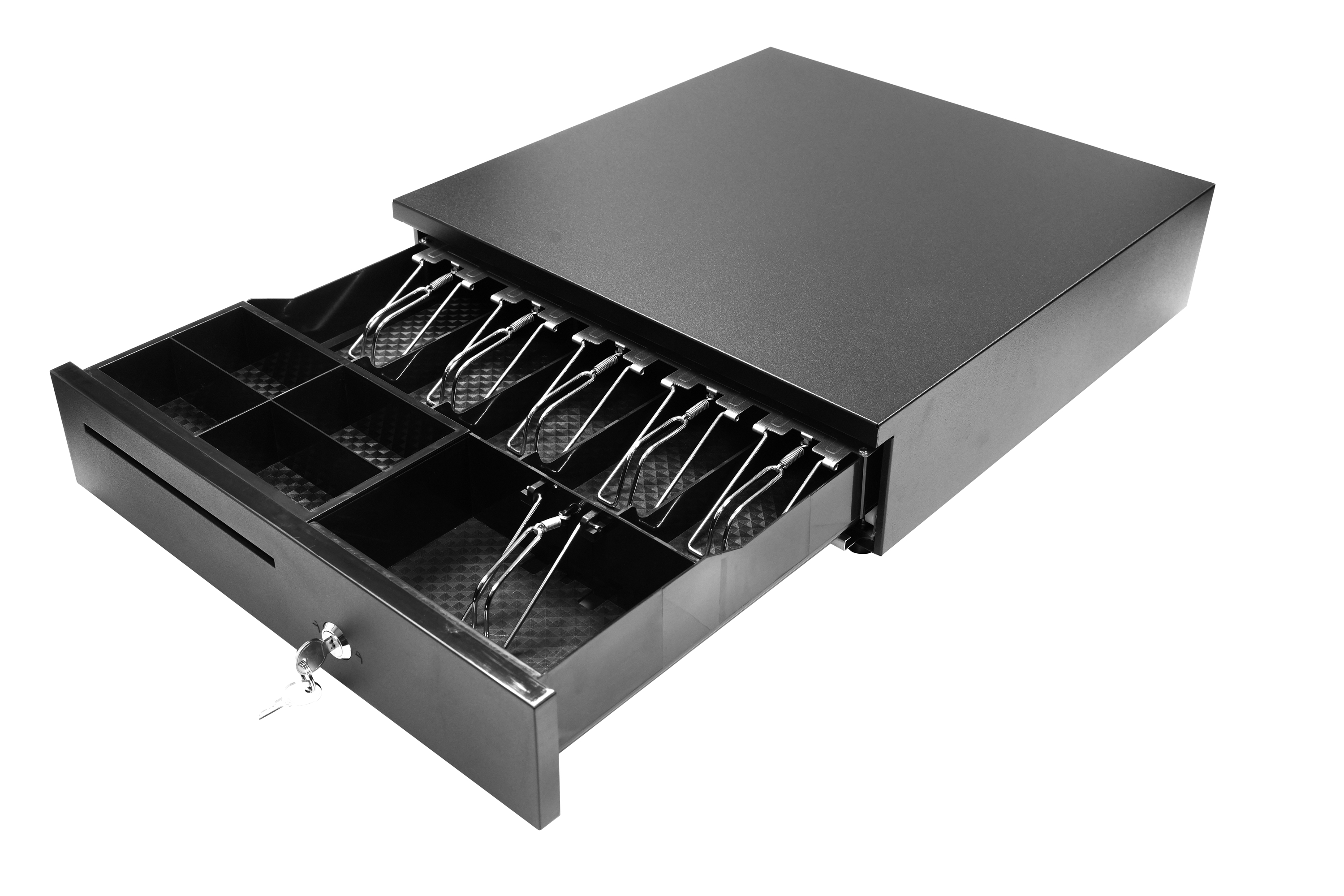
Fit Scenarios for Supermarket Checkout Lanes
Narrow lane with limited counter depth
Use the LAS-335 as the first candidate when the bay is tight and the listed 335 x 368 x 80 mm envelope is the only one that leaves room for the cashier and the scanner. Its 4 bill compartments and 3/5 coin listing suit a lane with a moderate cash mix. Check the open travel and the coin configuration before ordering. If the coin volume is high, the LAS-335 may be too small even if it fits the bay.
Standard lane with a balanced note and coin mix
The LAS-405 is the balanced choice in this group: 405 x 420 x 100 mm, 5 bill and 6 coin compartments, 4.5 kg net weight, and a three-position lock. It fits the same listed footprint as the LAS-4042, so the choice between them should be made on compartment layout rather than external size. Choose the LAS-405 when the lane needs a relatively even split between bill and coin storage.
Lane with more bill separation
The LAS-4042 is listed at the same 405 x 420 x 100 mm size and 4.5 kg net weight as the LAS-405, but with 6 bill and 4 coin compartments and an adjustable coin and bill compartment. It is a closer fit when the store needs more bill separation and can work with fewer coin compartments. Because the external footprint is the same, a lane that already accepts the LAS-405 may be able to accept the LAS-4042, subject to the same open-travel, lock, and cable checks.
Lane with a broader coin mix
The LAS-410G and LAS-410A are listed with 5 bill and 8 coin compartments and a steel panel. They are the first candidates when the lane handles a broader coin mix or when the specification calls for a steel panel. The two models share the same 410 x 415 x 100 mm footprint and the same compartment count, but the listed net weight differs: 5.6 kg for the LAS-410G and 6.5 kg for the LAS-410A. Confirm what accounts for that difference before treating them as interchangeable. The LAS-410 pair is 5 mm wider and 5 mm shorter in listed length than the LAS-405, so check the bay and the open zone rather than assuming a direct swap.
Retrofit where the existing cutout is fixed
If the counter cutout is already fixed, start with the models that match the existing envelope. A 405 x 420 x 100 mm bay makes the LAS-405 and LAS-4042 the first candidates. A 410 x 415 x 100 mm bay points to the LAS-410G or LAS-410A. The LAS-335 is the smallest and may require a reducer or a new fixing if the existing bay is much larger. Do not fill a loose bay with packing material unless the installation method is approved; a drawer that moves under load can strain the cable and the lock.
Supermarket Cash Drawer Fit Checklist
Use this checklist before approving a model for a lane:
- Bay width, depth, and height measured with the counter front and hatch open.
- Clear opening measured separately from the internal bay.
- Drawer open travel checked against the cashier zone, bagging rail, and customer aisle.
- Lock head and key path checked with the drawer in the installed position.
- RJ11/RJ12 connector, voltage, pinout, and solenoid current matched to the printer or POS terminal.
- Cable route checked for sharp bends, moving slides, and service loop.
- Bill and coin compartment count matched to the store's cash mix.
- Internal compartment dimensions confirmed for coin rolls or large note bundles.
- Steel panel location and gauge confirmed for models that list a steel panel.
- Certificate scope matched to the exact model and destination market.
- Sample tested in the actual lane before a full rollout.
- Spare keys, lock replacement, and after-sales support confirmed.
Red flags include a drawer that touches the counter lip when opened, a key that cannot be removed without pulling the drawer out, a cable that is pinched at the back of the bay, coin compartments that are too shallow for the store's coin mix, and a certificate that names a different model or market. Any one of these can turn a low-cost drawer into a costly retrofit.
Procurement Checks for a Multi-Lane Rollout
Lane fit should be confirmed before a multi-lane order, not after the first delivery. LASPACK states that it was founded in 2013, operates a 4,200 m2 facility with 50 employees and 10 engineers, and produces 400,000 units per year, with 70% of output exported to more than 100 countries. For project planning, the company lists OEM/ODM customization for voltage and logo, a monthly capacity of 40,000 pieces, an MOQ of 100 pieces, and a lead time of 10-15 days. It also lists 100% testing and after-sales warranty, remote support, and technical guidance.
These figures are useful for planning a rollout, but they do not replace a lane test. Ask for a sample with the same voltage, connector, and compartment layout as the planned order. Confirm the printer model and the drawer kick-out specification. If the store uses a cash office or a safe, check whether the drawer layout supports the handover process. LASPACK cites a five-year, 50,000-unit cash drawer OEM program in Indonesia with stable operation and smooth checkout as a reference for high-volume POS integration; use that as a starting point for supplier discussion, not as a substitute for your own acceptance test.
Model-level pricing is not quoted in this guide because it depends on the configuration, order volume, customization, packaging, and freight. Use the cost drivers to structure the RFQ: drawer size, steel panel, lock specification, interface, compartment layout, color or logo customization, MOQ, and delivery terms. A clear RFQ with lane dimensions and printer details produces a more useful quotation than a request for a generic cash drawer.
Frequently Asked Questions
Which certifications should I check for a supermarket cash drawer in the EU or US?
For the EU, check CE and RoHS documentation; for the US, check FCC documentation. LASPACK's supplied records list CE certificate M2506016AY-C0127 and RoHS certificate M2506016AY-C0128 issued by MEiOU, valid from 2025-06-12 to 2030-06-12. The FCC record is M2506016AY-C0127 with a Class B, Zone 2 scope under 47 CFR Part 15 Subpart B. Confirm the certificate scope against the exact model and destination market before relying on it.
How do I calculate whether a cash drawer will fit my checkout lane?
Measure the bay width, depth, and height, then measure the clear opening with the counter front or hatch in place. Add the space needed for the cable, lock key, and mounting hardware. Check the drawer's open travel, not only its closed length. Compare those measurements with the listed dimensions of the candidate model, and confirm the slide travel and key clearance with the supplier or a sample.
Which LASPACK model suits a narrow supermarket lane?
The LAS-335 is the smallest model in this group at 335 x 368 x 80 mm, with 4 bill compartments and a 3/5 coin listing. It is the first candidate when the bay is tight. Confirm the coin configuration and the open travel before ordering. If the lane handles a high coin volume, check whether the LAS-405 or LAS-410 series can fit before accepting the smaller compartment layout.
Should I choose 5 bill / 6 coin or 5 bill / 8 coin?
Choose by the store's cash mix, not by the larger number alone. The LAS-405 has 5 bill and 6 coin compartments. The LAS-410G and LAS-410A have 5 bill and 8 coin compartments. More coin compartments can help a lane with a broader coin mix, but the drawer must still fit the bay and the open zone. The LAS-4042 offers a different balance: 6 bill and 4 coin compartments in the same listed footprint as the LAS-405.
What drives the cost of a cash drawer retrofit?
The main cost drivers are the model and size, the steel panel specification, the lock, the voltage and interface, the compartment layout, customization, order volume, packaging, and freight. Model-level pricing should be confirmed in a quotation. A retrofit can also require counter modification, cable routing, or a new fixing, so include installation work in the budget rather than comparing drawer prices alone.
What are the MOQ and lead time for LASPACK cash drawers?
LASPACK lists an MOQ of 100 pieces and a lead time of 10-15 days. The company also lists OEM/ODM customization for voltage and logo, a monthly capacity of 40,000 pieces, and 100% testing. Confirm the MOQ, lead time, and customization requirements for the exact model and order before planning a lane rollout.
Can I get a sample before a full supermarket lane rollout?
Yes. Request a sample with the same voltage, connector, and compartment layout as the planned order. Test it in the actual lane for open travel, key clearance, cable routing, and cashier reach. Share the lane dimensions and printer details with LASPACK so the sample can be checked against the fit constraints. The brochure below summarizes the cash drawer range for procurement teams.
Conclusion
Cash drawer fit in a supermarket checkout lane is a sequence of constraints: bay size, open travel, compartment layout, construction, lock access, printer interface, and certification. The LAS-335 addresses the tightest footprint; the LAS-405 and LAS-4042 share a standard 405 x 420 x 100 mm envelope but split the cash mix differently; the LAS-410G and LAS-410A add 8 coin compartments and a steel panel for lanes that need them. Selecting among them should start with measurements from the actual lane and a printer check, not with a catalogue photo.
Before a rollout, test a sample in the installed position and confirm the certificate scope for the destination market. For a fit review, share your counter dimensions with LASPACK and request the current cash drawer brochure: download the LASPACK cash drawer brochure.
Have Questions or Need More Details?
Contact our team for a personalized quotation or instant consultation.
Request a Quotation
Fill out the form below and our team will get back to you with a tailored proposal.
WhatsApp Direct Chat
Prefer to chat in real-time? Message us on WhatsApp for instant assistance & quick answers.
- Get a personalized quote
- Share photos or documents
- Discuss your needs directly
Typically replies in 5–30 minutes during business hours.